
The new advisory and integration guideline („BIR“) recently published by the Bavarian Ministry of the Interior, for Sport and Integration is quite interesting.
Some of its passages read like an immediate confrontation between civil society engagement and non-evidence-based, more vibe-based symbolic politics.
Under section 5.2, activities are listed as „disruptive behavior“ that seeks to circumvent, interfere with, or even prevent the payment card measure.
The payment card has been available in Bavaria since the end of June 2024. It is a prepaid debit card on which refugees are charged for services under the Asylum Seekers’ Benefits Act. Only a flat-rate of 50 euros can be withdrawn from this credit each month in cash.
The introduction of the payment card was justified on the grounds that such a system would prevent refugees from transferring social benefits abroad.
The catch is that there is not a single empirical evidence for this general assumption. Given the already modest benefit levels under the Asylum Seeker Benefits Act, one must also wonder how such a drain of social benefits should even function when the same money must simultaneously be used to ensure one’s own survival.
In short: The payment card is expensive to manage, complex to implement, extremely participatory, and based more on a feeling than on facts.
For this reason, since the introduction of the payment card, numerous civil society initiatives have taken on the task of organizing a card exchange.
The idea is of a disarming simplicity: Refugee people use the payment card to buy, for example, vouchers for supermarkets. They then exchange these vouchers at the exchange stations and receive the voucher value in cash in return.
This is neither particularly complicated nor particularly subversive. It is a practical, humane response to a practical, anti-humanitarian restriction.
Attempts to criminalize card exchanges have failed miserably.
A Munich organization that organizes such a solidarity card exchange is Open!
The state capital Munich, Lichterkette e.V. and the Munich Migration Advisory Board awarded the solidarity card exchange project Offen! with the „Lichtblicke“ award for funding.
The jury’s justification states: „The card exchange is a strong sign against a policy of exclusion and in favor of safeguarding the fundamental rights of refugees.“ Moreover, it enables personal exchange between volunteers and refugees.
These lines date from July 2026.
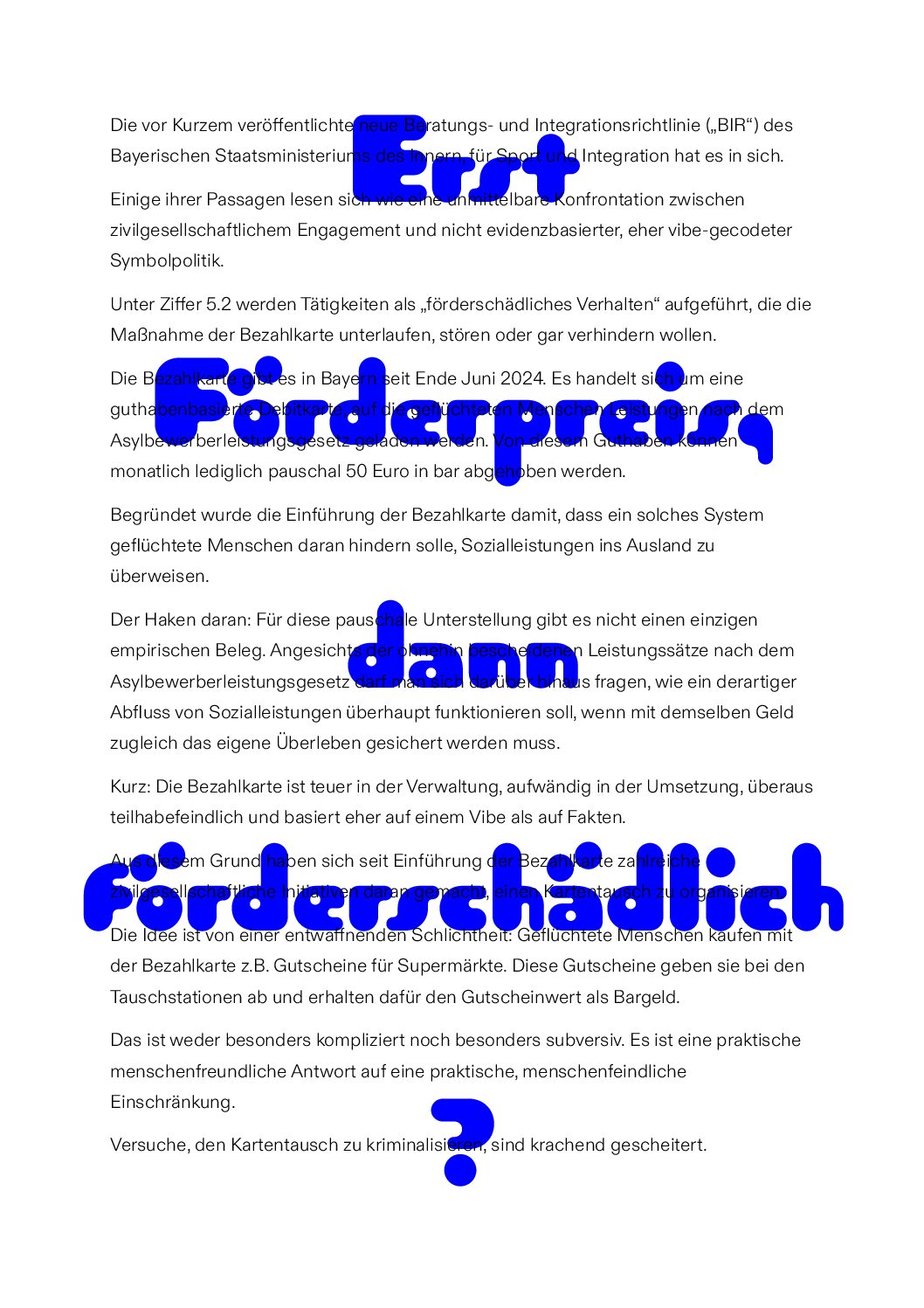
From January 2027 onwards, according to the BIR, the exact same activity will no longer be fundamental rights-friendly and integration-promoting, but „harmful to integration“.
In July, therefore, a grant award is made to an initiative that advocates for the fundamental rights of refugees. In January, the same activity can mean the loss of funding.
Neither have the approaches of the initiatives changed, nor has the payment card become any different.
An astonishing discrepancy between the city and the countryside.
At the state level, however, it seems that there is not complete certainty about what one actually wants. According to the self-proclaimed goals of the Bavarian Ministry of the Interior, the refugee and integration advisory service is supposed to promote, among other things, the „participation and equal opportunities of people with a migration background in all areas of social life.“.
Participation and equal opportunities.
And since Bavarian Interior Minister Herrmann (CSU) announced in 2018 that the so-called Cross Decree would be implemented: „We see no reason to review [the Cross Decree] – and we welcome every [Christian] cross that is attached. The more crosses, the better,“ it is worth taking a brief look at the Book of the Third Book of Moses:
„If a foreigner sojourns with you in your land, you shall not oppress him. He shall be to you as a native among you, and you shall love him as yourself; for you were aliens in the land of Egypt.“