
With sparsely occupied benches, the CDU/CSU, AfD, and SPD voted against the decriminalisation of fare evasion last Thursday.
Against the backdrop of the staid grey of the high house of democracy, Parliament once again failed to bestir itself to consign a relic of regulation from 1935, along with its long-outdated meaning and purpose, to the waste bin of history.
In an astonishing continuity with the era between the Middle Ages and the early modern period, a decision is made to preserve the debtors' prison and punish the propertyless for their lack of property. What is more, it proves that class society is not a definitional artefact, but rather that even today it is maintained through a conscious social construction of scarcity.1 and denied access to basic needs.
Legally, the criminalisation of travelling without a ticket is concealed behind Section 265a, Paragraph 1, Alternative 3 („Obtaining services by deception“) of the Criminal Code.
The birth of this norm can be traced back to 1935. The offence was incorporated into German criminal law by the National Socialists and, with few modifications, continues to this day. The dictatorial regime reacted to a ruling by the Reichsgericht, which was deeply entrenched in the National Socialist unjust regime, by creating this offence. Despite sometimes excessive, ideologically motivated interpretations of the law, the Reichsgericht had failed to subsume the misuse of public payphones using manipulated two-pfennig coins under an existing criminal norm.2
It would be too simple to derive the current societal illegitimacy of a norm solely from its NS provenance. The provenance argument alone doesn't hold up. Structural issues are far more crucial. Has the pernicious spirit that once produced § 265a of the German Criminal Code been preserved in its current application? Does what was conceived in 1935 as an instrument for disciplining societal fringe groups continue to operate in precisely the same direction today? The answer is startling and brief: Yes. With almost surgical precision, the application of § 265a of the German Criminal Code today affects those who, by virtue of their lack of assets, are already on the fringes of society.
For over ninety years, § 265a of the German Criminal Code has provided for a penalty of up to one year's imprisonment or a fine. In judicial practice, such proceedings rarely lead directly to imprisonment. In the vast majority of cases, a fine is imposed.
But what awaits those people who are unable to pay the fine imposed on them, regardless of whether their lack of assets is their own fault or not?
In principle, you have the option to avoid the penalty through community service. If this is not possible, for example due to a lack of a permanent residence or as a result of an addiction, the so-called substitute custodial sentence applies. Indigent individuals do not pass „Go“ but go straight to prison.
The substitute custodial sentence is a costly undertaking for the countries and therefore the taxpayers. Depending on the federal state, the cost of one day in prison is estimated to be between 98 and 188 euros.3
These abstract figures require a concrete example: if we assume 20 days of detention and the lower rate of €98, a single such case costs the state almost €2,000. The price for an offence, the underlying damage of which is an unsolved ticket. The state therefore spends a multiple of what it purports to protect. Anyone who speaks of prevention and asset protection here must explain what they actually mean.
Following John Rawls‘ Theory of Justice Justice is the first virtue of social institutions. No laws, however efficient and well-arranged, must be modified or abolished if they are unjust. Every person must possess an inviolability founded on justice that even the welfare of society as a whole cannot override.4 Social and economic inequalities require two conditions in order to be justified at all: they must be based on offices or positions that are open to everyone under conditions of fair equality of opportunity, and they must benefit the least advantaged the most.5
If this principle of differentiation is applied to the substitute custodial sentence, the existence of the norm not only becomes questionable but its logic is virtually reversed. The norm places a burden exclusively on those who are already in the worst position. In contrast, no one benefits from it. It is therefore not only unjust in the colloquial sense but also violates the criteria of the principle of differentiation on both counts.
The defenders of the norm must therefore show that it also benefits the weakest members of society. No one has yet convincingly provided this proof.
Consequently, the currently codified criminalisation of fare evasion also fails this test of justice.
§ 265a of the German Criminal Code (StGB) fundamentally punishes impecuniosity itself, not driving without a ticket. Impecuniosity first leads to limited participation in communal resources (in this case, public transport) and then, in a second step, to a direct state intervention in personal liberty. In a society where freedom has value, its deprivation is constituted as a general penalty. Those who possess nothing ultimately only have their body left, i.e. their freedom, and it is precisely this that becomes the collateral for the sanction.
So, what is the purpose of imposing sanctions? They neither relieve the national budget nor the transport companies. Only a fraction of those affected travel without a ticket out of mischief. The vast majority do not buy a ticket due to economic hardship. The regulation has no preventative effect but rather fuels a downward spiral at the social margins. Anyone genuinely concerned about the principle of solidarity should therefore advocate for a socially tiered tariff or a sufficiently funded social ticket, rather than for the retention of a norm that punishes poverty with deprivation of liberty.
Even in the 18th century, Native American thinkers who had the opportunity to observe French society closely recognised a fundamental difference from their own communities. In these, there was no direct way to convert wealth into power over other people. Property ownership had little impact on personal freedoms. In European society, on the other hand, power through possessions could be directly exchanged for power over other beings and their freedom.6 Conversely, lack of assets led to the loss of personal freedom.
This observation remains as relevant as ever. Indigenous philosophers described not an anomaly, but a structural principle.. It is precisely this principle that lives on in § 265a of the German Criminal Code to this day. The silent equation, whereby a lack of possession is translated into a lack of freedom. German criminal law did not invent this equation, but it codified it and imbued it with the aura of the rule of law.. This immediately reveals the contemptible nature of Section 265a of the German Criminal Code (StGB). The norm represents a perpetuation of age-old societal injustices by modern means.
Perhaps our society and our criminal law have far more in common with 18th-century France than we would like to admit. It is therefore no wonder that the present day sometimes feels like a road pointing backwards rather than forwards. What is missing is the meta-narrative, the convincing narrative of forward-looking politics in a contradictory present. Instead, injustice is given continuity. However, a social system that is to function sustainably and earn the trust of its people must be built on justice.
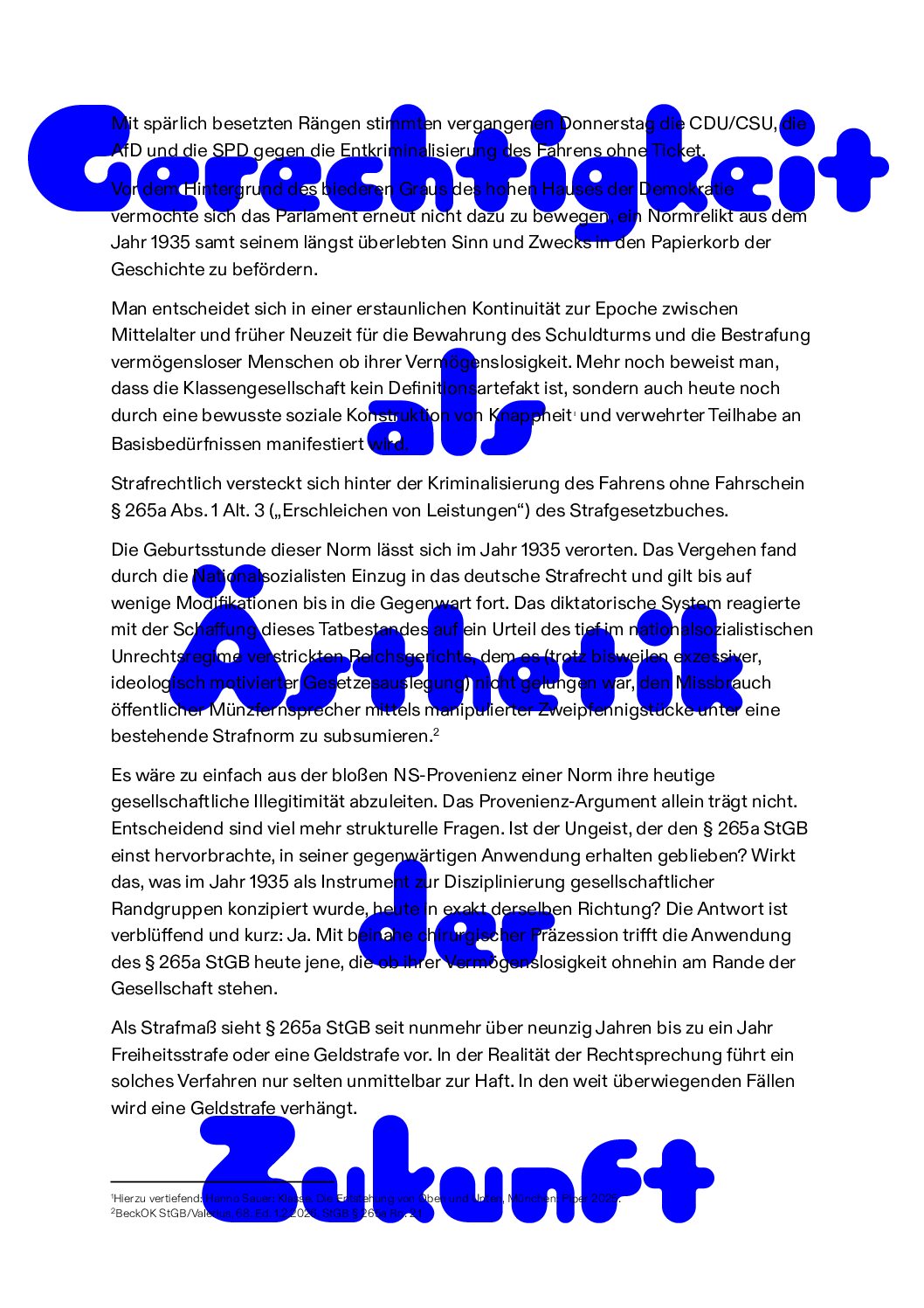
Why does the article's headline then speak of justice as the aesthetic of the future? Why aesthetic? Because aesthetic doesn't merely mean beautiful, but rather fitting. It describes the inner coherence of a form.
A society that proclaims freedom and dignity as its highest values, while simultaneously imprisoning the poorest for their poverty, is in this sense unaesthetic. It contradicts its own fundamental principles. Justice would then not only be a moral demand but also the formative principle that gives a society its inner shape. The future to be designed is one in which form and content no longer diverge..
So justice can be the aesthetic of the future. A first, small step into this future aesthetic would be the abolition of § 265a of the German Criminal Code.
- For a deeper dive into this, see: Hanno Sauer: Klasse. Die Entstehung von Oben und Unten, Munich: Piper 2025. Turn over
- BeckOK StGB/Valerius, 68th ed. 1.2.2026, StGB § 265a para. 2.1. Turn over
- https://fragdenstaat.de/artikel/exklusiv/2021/12/fahren-ohne-fahrschein/, last accessed 20.04.2026, with further references. Turn over
- John Rawls: A Theory of Justice. Suhrkamp, Frankfurt am Main 1979, pp. 19f. Turn over
- John Rawls: Justice as Fairness: A Restatement. Edited by Erin Kelly. Suhrkamp, Frankfurt am Main 2006, p. 78. Turn over
- Graeber, David/ Wengrow, David: The Dawn of Everything. A New History of Humanity. London: Allen Lane, 2021, p. 68 Turn over